


In today’s interconnected global economy, countries borrow money from foreign lenders for various reasons—like funding infrastructure, stabilizing currency, or dealing with emergencies. This borrowed money is called external debt, and it includes both government debt (money borrowed by national or local governments) and private debt (loans taken by businesses and individuals from foreign sources).
External debt must be paid back in internationally accepted currencies (like US dollars or euros), goods, or services. Although having high external debt might sound risky, it doesn’t always mean a country is struggling. A nation could owe a lot but still be financially strong if it also holds large amounts of foreign assets. In that case, it could actually be a net lender to the world.
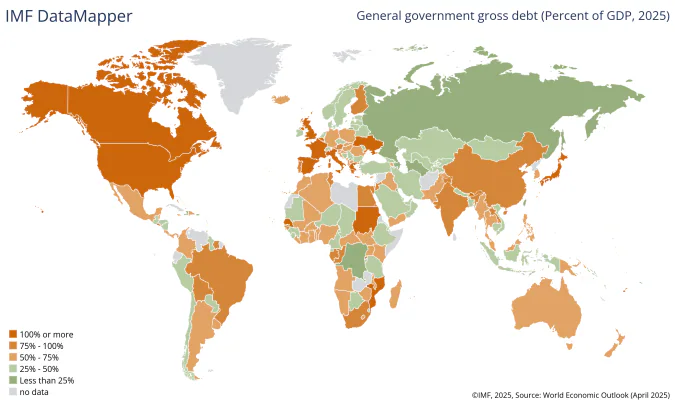
Below is a simplified snapshot of the world’s top countries and regions by external debt as of September 2024.
Key Takeaways:
- External debt includes money owed by governments and private sectors to foreign lenders.
- Some countries have high debt per person, even if their populations are small.
- A high debt-to-GDP ratio may indicate greater financial risk, but context matters.
- Wealthier countries tend to have higher absolute debt but often manage it more sustainably.
Top Countries by External Debt (September 2024)
| Country/Region | Total Debt (USD) | Debt Per Person | % of GDP | % of National Wealth |
|---|---|---|---|---|
| United States | $25.8 trillion | $75,852 | 88.45% | 18.44% |
| European Union | $18.6 trillion | $41,410 | 95.87% | 24.50% |
| United Kingdom | $10.5 trillion | $152,271 | 293.48% | 65.91% |
| France | $8.19 trillion | $119,450 | 249.57% | 51.25% |
| Germany | $7.12 trillion | $85,266 | 144.60% | 40.84% |
| Japan | $4.63 trillion | $37,502 | 105.59% | 20.52% |
| Netherlands | $4.4 trillion | $243,753 | 345.55% | 90.34% |
| Luxembourg | $3.93 trillion | $5.85 million | 4,052% | 1314.28% |
| Ireland | $3.31 trillion | $614,404 | 562.93% | 362.07% |
| Canada | $3.17 trillion | $76,474 | 136.08% | 28.15% |
What Do These Numbers Mean?
- Debt Per Capita: This shows how much debt each person would owe if the total were divided evenly.
- % of GDP: This compares debt to the country’s economy size. Over 100% means the debt is larger than the annual economy.
- % of Wealth: This puts debt in the context of the country’s overall wealth.
Some smaller countries like Luxembourg and Ireland have very high debt per person and GDP ratios, largely due to their roles as financial hubs. These numbers may seem alarming at first glance, but they often reflect strong, service-based economies that handle large international financial flows.
External debt is a crucial indicator of a country’s economic ties and financial obligations to the rest of the world. While high debt levels can be risky, especially when not supported by a strong economy or financial management, they are not always a sign of trouble. Context—like income levels, foreign assets, and economic growth—matters greatly.
Understanding how much a country owes helps policymakers, investors, and citizens grasp the broader economic picture. As global finance continues to evolve, tracking external debt remains vital to assessing a country’s economic health and stability.